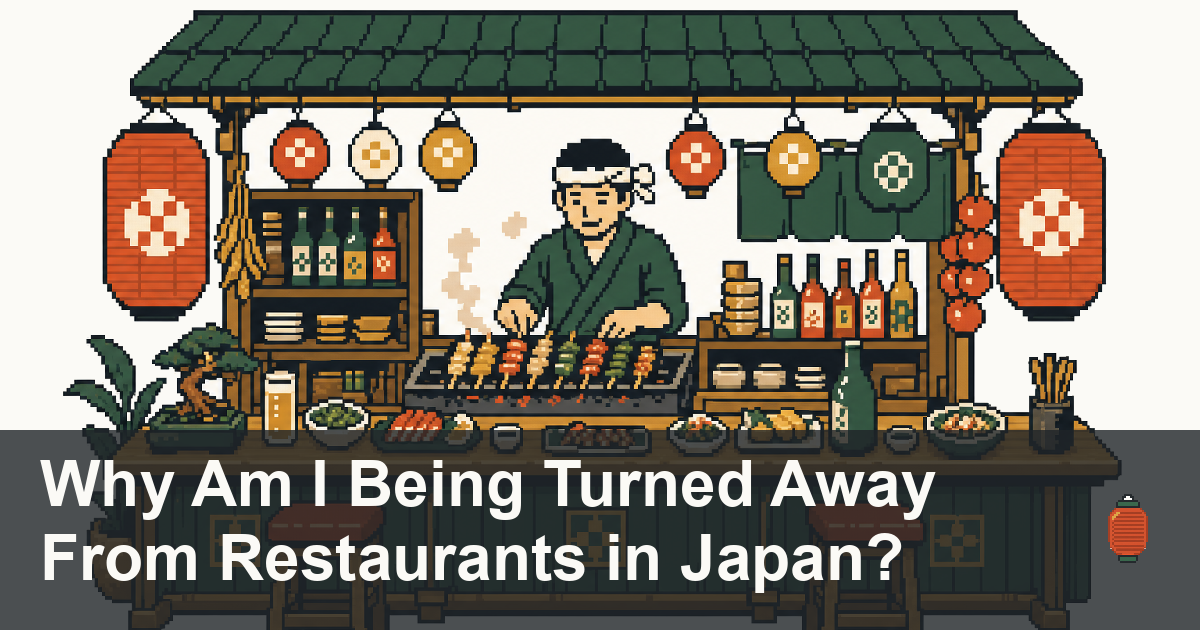
Quick answer: if a Japan restaurant turns you away, it is often capacity, language, rules, or reservation friction; switch calmly to a backup rather than arguing at the door.
You found the place. Steam on the windows, six seats at a wooden counter, a chef with a knife and a face like a calm storm. You pull the door. He looks up, crosses his arms into a slow X, and says one word you don’t understand. You step back onto the street, cheeks hot, dragging your suitcase past the next group already laughing their way in. What just happened? Was it me?
I’m Reo Matsuda. I was born in Tokyo and I built OnlyLocal because I watched this exact scene play out hundreds of times. Here’s the part nobody tells you on the generic “why” blogs: the X at the door is almost never discrimination. It’s seating math, language overhead, and a few deep no-show scars. And once you can read the signals before you touch the door, you basically stop getting refused. Let me show you how.
 Mia
Mia Yuki
Yuki Mia
Mia YukiMia
 Yuki
YukiThe real reasons you’re being turned away (and why “racism” is usually the wrong story)
The internet loves the dramatic version. The honest version is more boring and far more fixable. Here are the four actual reasons, in roughly the order you’ll hit them.
1. Manseki — the restaurant is simply full
満席 (manseki) means “all seats occupied.” Japanese staff will say “Moushiwake gozaimasen, tadaima manseki desu” — “So sorry, we’re full right now” (per byFood and multiple Japanese dictionaries). Tiny counters in Tokyo run on a knife’s edge: eight stools, one chef, two seatings. There is no “we’ll squeeze you in.” This is the most common rejection by a mile, and it’s the one that feels personal but absolutely isn’t.
2. Language overhead, not language hatred
A solo chef cooking, plating, pouring, and ringing up eight people cannot stop to mime through a 20-minute order. Japanese law permits refusing service for genuine language reasons; refusing based on race or nationality violates Japan’s constitution (as byFood and HiNative threads note). Many owners turn people away out of embarrassment that they can’t serve you well — not contempt. It reads identical at the door, but the cause is fixable: show up where English is already handled.
3. No-show scars are real and recent
This one matters in 2025–2026. A third-generation Tokyo sweets shop (Kobikichō Yoshiya) went viral in November 2025 after its owner reported 2–3 groups of foreign tourists no-showing reservations every single day, ignoring LINE and phone reminders (reported by Unseen Japan). Foreign guests were only ~10% of his business but a wildly disproportionate share of his empty, paid-for seats. Multiply that across Tokyo and you understand why some small places now quietly avoid walk-in tourists, or demand a card on file. Tabelog’s multilingual booking now requires credit-card registration so cancellation fees can be enforced (reported by Real Japan Guide). You’re paying for other tourists’ broken promises.
4. Ichigensan okotowari — “no first-time guests”
一見さんお断り (ichigensan okotowari) literally means “refusing those who appear for the first time.” It comes from Kyoto’s geisha world: you get in only via introduction from an existing regular (CNN and multiple sources). A handful of invite-only Tokyo counters and bars run the same way. It is not anti-foreigner — plenty of Japanese people get turned away too. It’s a trust filter. You don’t beat it by arguing; you beat it by not aiming at those doors in the first place.
 Yuki
YukiRead the door before you touch it: the signal table
Ninety percent of refusals are avoidable because the building is telling you what it is. Here’s the cheat sheet I give every friend who visits.
| Door signal | What it actually means | Your move |
|---|---|---|
| 満席 sign, or staff crossing arms into an X / pointing at watch | Manseki — full house. Pure capacity, not rejection. | Ask if there’s a later slot; otherwise move on, zero shame. Come back at off-peak (right at open, or 2–3pm). |
| 会員制 (kaiinsei) / “Members” / no menu, no prices, unmarked door | Members-only or ichigensan — entry by introduction. | Don’t pull the door. This isn’t for walk-ins of any nationality. Pick a different place. |
| 予約のみ / 予約制 (yoyaku) / “Reservation only” | Booked-ahead only; walk-ins not accepted even if empty. | Book online in advance — never assume walk-in. See our reservation guide for foreigners. |
| 貸切 (kashikiri) | Private charter tonight — the whole place is booked by one group. | Closed to the public for the evening. Move on; nothing personal. |
| Course-only / prepaid omakase, card required to book | Set course, deposit or full prepay; same-day cancel = full charge. | Fine if you intend to keep it. Only book what you’ll honor — no-shows are why doors are closing. |
| Tiny counter (4–8 stools), all-Japanese menu, no photos | High language overhead for a solo chef. | Have a translation app open, order simply, or choose an English-menu spot instead. |
| のれん (noren curtain) hung out, lights on, lantern lit | This is the good signal — they’re open and taking guests. | Lift the curtain, step in, say “Hitori desu” (one person) or hold up fingers for your group size. |
 MiaYuki
What to actually say at the door (romaji + English)
You don’t need to speak Japanese. You need five short phrases that signal you’re easy, respectful, and not going to be a 20-minute project. Say them with a small bow and a smile and watch how many “no”s turn into “hai, douzo.”
- “Sumimasen, hitori desu. Ii desu ka?” — Excuse me, just one. Is that okay? (Swap hitori for futari = two, or just hold up fingers.)
- “Yoyaku nashi demo daijoubu desu ka?” — Is it okay without a reservation?
- “Eigo no menu wa arimasu ka?” — Do you have an English menu?
- “Manseki desu ka? Nanji nara aite imasu ka?” — Are you full? What time would have space?
- “Daijoubu desu, arigatou gozaimasu!” — No problem, thank you! (Use this when it’s a no — leaving graciously keeps the door open for the next traveler.)
That last one matters more than you think. A polite exit when you’re turned away is part of why the next foreigner gets a warmer welcome. We’re all building each other’s reputation at these counters.
How to basically stop getting refused
The whole game is pre-selection. You don’t argue your way past a no; you aim at doors that are already a yes.
- Go off-peak. Manseki is a 7–8pm problem. Walk in right at opening or for a late-afternoon meal and tiny counters are wide open.
- Filter for an English menu when you want zero friction. It removes the entire language-overhead reason in one move — see our roundup of Tokyo restaurants with English menus.
- Book ahead for anything course-based or famous, and then actually show up. Our foreigner reservation guide walks through the apps that work in English.
- Learn the small-room etiquette so the chef relaxes the second you sit down — our etiquette guide for tiny Tokyo restaurants covers it. And if you want the famously gatekept-but-actually-friendly scene, here’s how to do Golden Gai as a foreigner without getting waved off.
- Use a vetted list. This is exactly why OnlyLocal exists. Every spot carries a foreigner-safe label — walk-ins welcome, English handled, no surprise members-only doors — so you tap, walk, and eat instead of getting the arm-X.
MiaYukiFAQ
Is it legal for a Japanese restaurant to refuse me for being foreign?
Refusing service purely for genuine language reasons is legal in Japan, but refusing based on race or nationality violates Japan’s constitution (as reported by byFood and discussed widely on HiNative). In practice, the vast majority of refusals are capacity (manseki), reservation-only, or language overhead — not nationality discrimination.
What does it mean when the chef crosses his arms in an X?
It’s the standard non-verbal “no / not possible,” almost always meaning manseki (full) or that walk-ins aren’t accepted. It’s not an insult. Reply “Daijoubu desu, arigatou gozaimasu,” bow slightly, and move on.
Why do some places want my credit card just to book?
Because tourist no-shows have hit small restaurants hard — one Tokyo shop reported 2–3 foreign no-shows daily in late 2025 (reported by Unseen Japan). Platforms like Tabelog now require card registration so cancellation fees can be charged (reported by Real Japan Guide). If you book it, keep it — or cancel early through the app.
How do I tell a members-only place from one I can just walk into?
Watch for 会員制 (kaiinsei / “members”), an unmarked door with no menu or prices, or anything described as ichigensan (introduction-only). When in doubt, a hung-out noren curtain with the lantern lit is the universal “open, come in” signal — and reservation-only spots usually say 予約制 right on the door.
The door isn’t a verdict on you. It’s a sign you can learn to read in an afternoon — and once you can, Tokyo opens up. Start with my vetted, foreigner-safe picks and go eat well tonight.
— Reo Matsuda, Tokyo. Founder of OnlyLocal.


Comments